For several years, AgroRegion Group of Companies has been taking an individual approach to its fields and applying fertilizers according to the needs of each one. In an article by Rostyslav Panichev for iFarming magazine, Yurii Lysak, Chief Agronomist at AgroRegion, explains how to “break” fields down into smaller management zones and apply precision farming approaches at AgroRegion.
Achieving consistent results is relatively straightforward when a farm’s fields have broadly similar soil characteristics. In such conditions, crop production is simple: apply a set rate of nutrients uniformly across the entire field without having to consider how this approach may ultimately affect profitability. The situation is quite different at AgroRegion, whose land bank spans Chernihiv, Kyiv, and Zhytomyr regions. This is what we discussed with Yurii Lysak, Chief Agronomist of the holding.

— Mr. Lysak, how different were the soils managed by AgroRegion from what you had encountered elsewhere?
— When I joined the company, I immediately noticed the variability that I had not encountered in other regions where I had worked. One thing is the chernozem areas of Zhytomyr Region. But Kyiv Polissia is a completely different story. These areas differ not only in terms of climate. Just look at what we have in the north: there are sandy soils as well as low-lying, waterlogged areas. This means one thing: if we want to achieve the desired level of profitability, we need to find a way to manage this variability.
— Is there a way to work effectively with such soils?
— If you analyze the problematic fields, it becomes clear that their soil composition is not uniform. For example, clay soils retain moisture better, while sandy soils do not. The problem may even be that a low-yielding area is located in a low-lying part of the field where crops suffer from excess moisture every year and therefore fail to produce good yields. Conversely, in a dry year, that same area may produce the highest yield.
In addition, we realized that we needed to address soil acidity. Detailed analysis showed that differences in soil acidity can occur both between fields located just one kilometer apart and within the same field. The holding even has areas where the soils are acidic, while just beyond a small forest, the soils are alkaline. We even have alkaline sandy soils, although I had previously assumed that sandy soils were predominantly acidic in terms of soil solution reaction.
— Did you conduct the soil analysis yourselves?
— Of course not. It was all done by a laboratory. Four years ago, we started looking for a laboratory and partners who could carry out all the necessary soil analyses to a high standard and, in addition, provide recommendations on fertilizer application. We tried working with different providers to determine whom we should continue working with. When it came to soil characteristics, they all produced broadly similar results, but their fertilizer recommendations often differed.
We decided to test these recommendations. We selected two highly variable areas totaling 2,000 hectares at two farms. In terms of their characteristics, these areas were considered relatively low-yielding. On good land, everything is fairly straightforward — soil fertility can compensate for problems in potentially challenging areas. But poorer soils, especially where rainfall is also limited, reveal all these differences very clearly.
It turned out that the specialists at AgriLab were the most experienced and precise in this regard. Their laboratory analyses showed that the fields varied significantly in terms of both potassium and phosphorus content and soil acidity. The laboratory developed a comprehensive system specifying what should be applied and where on the trial fields. Moreover, this fertilization system differed fundamentally from what the farms had traditionally been using.
— What was it about the laboratory’s recommendations that convinced AgroRegion to continue working with them?
— First and foremost, it was the reduction in fertilizer costs and the focus on nutrients that we had previously overlooked. We followed all of the laboratory’s recommendations on the trial fields. In particular, they suggested reducing fertilizer application rates. At the same time, they recommended paying attention to liming and applying zinc — an element that many people simply overlook or do not consider at all.
As a result, yields on the trial fields were comparable to those on the control fields, while fertilizer consumption was lower. In monetary terms, the farm’s traditional technology cost $192 per hectare of corn. The approach recommended by the laboratory, however, cost more than $40 less.
FACT SHEET
Today, AgroRegion cultivates 38,000 hectares of arable land, with approximately 40–45% allocated to corn and 15–20% to sunflower. Each year, both crop yields and the profitability of their production continue to increase.
“And variable-rate mineral fertilizer application plays a major role in this,” comments Yurii Lysak. “Under today’s conditions, this technology not only helps us achieve higher yields per hectare, but also allows us to use every hryvnia invested in production more efficiently.”
— What results have you achieved thanks to the recommendations and variable-rate fertilizer application?
— It turned out that the northern regions — Chernihiv and Kyiv regions — have high phosphorus levels. Therefore, the rate of phosphorus fertilizer application was reduced on farms in these areas. For the past two years, fertilizer rates in these regions have been reduced by 50–60%, while some fields have such high phosphorus levels that only starter fertilizers are needed.
By contrast, the chernozems in Zhytomyr Region turned out to be deficient in phosphorus despite having high potassium levels. However, since phosphorus fertilizers are more expensive than potassium fertilizers, costs on these fields increased slightly. That is why we say that variable-rate application not only allows us to save on fertilizers across the entire agricultural holding, but also to optimize their application according to specific soil and climatic conditions, which ultimately has a positive effect on profitability.
— What equipment do you use to apply fertilizers and lime according to the recommendations?
— As for lime, we used the existing machinery already available on the farms. It is quite straightforward: one part of the field might require two tonnes per hectare, while another requires four. This can be achieved simply by changing the application speed. The operator has the application map in front of them, and where the required rate is lower, they simply drive twice as fast.
Phosphorus and potassium, however, required us to select new and modern equipment capable of variable-rate fertilizer application. There were several brands of similar machinery on the market, so we decided to test it thoroughly before making a purchase. Eventually, we chose Amazone ZG-TS 8200 trailed spreaders, of which we now have three.
Amazone ZG-TS 8200 effectively applies fertilizers according to prescription maps
Initially, the machinery operators at the farms were concerned that such a large machine would get stuck in the field and be difficult to operate. However, in practice, one Amazone ZG-TS 8200 proved much more efficient at carrying out the required tasks than the old three-tonne spreaders that were available at AgroRegion Group farms at the time.
We also liked the fact that one such spreader can replace three smaller ones. This means fewer tractors are needed, faster loading, and higher field productivity. Over three seasons, one of the spreaders has already covered approximately 78,000 hectares, applying 10,000 tonnes of fertilizer at an average rate of 120 kg/ha. In short, we are completely satisfied with this equipment.
— What challenges did you encounter when setting up your variable-rate application system?
— One of the mistakes we made at the very beginning was the soil sampling scheme, which was based on taking one sample per 10 hectares using a grid.
Since 2018, we have been creating yield maps. Using these maps, together with NDVI imagery, we saw that our fields contained many different areas with distinct characteristics.
On our fields, we identify specific zones of variability that recur from year to year. A single field may contain several such zones. In some cases, as many as six sectors with different yield characteristics can be identified within a single field. Soil samples are now collected taking these data into account, which provides a much more accurate picture of nutrient levels and soil acidity. Whereas such detailed analysis previously had little practical value, with the new Amazone equipment we can now put all this data to practical use in the field, applying each nutrient at the rate required for a specific location.
The Amazone ZG-TS 8200 spreaders are equipped with a GPS-Maps software module that makes it possible to process application maps in Shapefile format. The system can be set either to the required application rate of the material or directly to the required amount of active ingredient.
— What would you advise other farmers who want to implement variable-rate fertilizer application on their fields?
— First, you need the motivation and the willingness to engage your colleagues in identifying and analyzing problematic and high-yielding zones. Without that, it is impossible to take the next steps. I would not recommend starting with equipment selection. First and foremost, you need to study your fields and understand the reasons behind high and low yields. Next, you need to find a laboratory whose analyses and recommendations you can fully rely on. Only then, once every field has been broken down into its individual “parts,” should you think about what equipment to use to apply the fertilizers.
Detailed analysis may show that fertilizer costs will not be reduced in certain areas. That was the case with our fields where we had to apply more phosphorus. However, this approach helps fully unlock the potential of each field and, ultimately, improve the overall profitability of the farm.
Rostyslav Panichev, iFarming
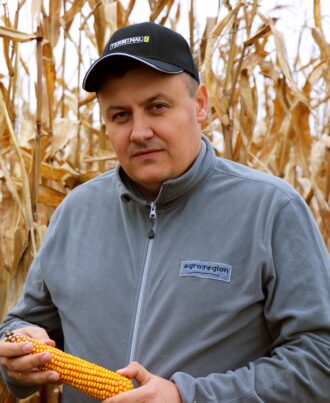
“Four years ago, we started looking for a laboratory and partners who could carry out all the necessary soil analyses to a high standard and, in addition, provide recommendations on fertilizer application. We tried working with different providers to determine whom we should continue working with. When it came to soil characteristics, they all produced broadly similar results, but their fertilizer recommendations often differed.
We decided to test these recommendations. We selected two highly variable areas totaling 2,000 hectares at two farms. In terms of their characteristics, these areas were considered relatively low-yielding. On good land, everything is fairly straightforward — soil fertility can compensate for problems in potentially challenging areas. But poorer soils, especially where rainfall is also limited, reveal all these differences very clearly.
It turned out that the specialists at AgriLab were the most experienced and precise in this regard. Their laboratory analyses showed that the fields varied significantly in terms of both potassium and phosphorus content and soil acidity. The laboratory developed a comprehensive system specifying what should be applied and where on the trial fields. Moreover, this fertilization system differed fundamentally from what the farms had traditionally been using. In particular, they suggested reducing fertilizer application rates. At the same time, they recommended paying attention to liming and applying zinc — an element that many people simply overlook or do not consider at all.”


