Rodovid LLC, based in Khmelnytskyi Region, is a relatively small farm by Ukrainian standards, cultivating 300 hectares. However, it is an excellent example of the fact that in agricultural business, what matters most is not scale, but efficiency.
Serhii Tomashenko, the farm’s manager, is a young and successful farmer of a new generation. Like any other agricultural producer, he is well aware of the challenges farmers face every year: fertilizer prices are rising, the weather is unpredictable, crop prices fluctuate, and uncertainty surrounding the land market does little to inspire confidence about the future.
Yet to stay ahead, Serhii Tomashenko follows a set of principles in his approach to farming. What are they? Read on…
Principle 1: Saving Means Not Buying More Than You Need
Fertilizers are the largest expense item for most farmers. And when you are paying significant amounts for them, you want to be sure that you are using exactly the fertilizers your field needs, applying them in the right way for maximum efficiency and in the right quantities. After all, a crop cannot “consume” more nutrients than it needs — any excess is simply wasted expenditure. But excessive cost-cutting can also have unpleasant consequences: underfeed the crop, and you will lose yield.
“You need to understand how much mineral fertilizer to apply — or whether you need to apply something at all. We wanted to see the differences between fields and determine where it makes sense to sow green manure. Now we can already see where organic matter levels are lower, and those areas definitely need green manure — and more of it,” notes Serhii Tomashenko.
To determine what to apply, where, how much, and how, the farmer decided to conduct comprehensive field agro-diagnostics.
“The guys came with a soil sampler and collected the samples in one day,” recalls the farm manager.
AgriLab’s comprehensive field agro-diagnostics begins with automated soil sampling, with each sampling point precisely georeferenced using GPS. This is followed by comprehensive soil agrochemical analysis and the development of field maps showing nutrient availability.
However, this is only the first stage. Comprehensive agro-diagnostics also includes analysis of weather and climatic data, historical and critical field factors. Using a proprietary algorithm, the natural potential of the field is also determined — data that serves as the foundation for developing economically efficient nutrient management recommendations tailored to a specific field.
Fertilizer recommendations are developed both for the planned yield and for the potential yield based on the field potential assessment. In addition, recommendations are developed for three crops per field.
Agro-diagnostics makes it possible to understand, for example, why different areas of the same field produce different yields, what the nutrient availability is in each area, where, what, and how much should be applied, and where costs can be reduced.
“You don’t want to just do things blindly. You want to see the real situation — for example, whether ammonium sulfate can be applied, whether the soil is acidic or alkaline. Everything needs to be taken into account and carefully assessed. Fertilizers are expensive, yet people apply them without knowing whether they are actually needed there. We need to keep moving toward better decisions! After the agro-diagnostics, I now know that my fields have sufficient potassium, so I can save on that, while phosphorus and nitrogen need to be applied at higher rates.”
Principle 2: Analysis and a Systematic Approach
Soil analysis is the foundation on which a crop nutrient management system and profitable agricultural production are built. Can a house exist without a foundation? It can. But it will not last long. The same applies to farming: to stay profitable, you need to analyze your fields.
“If you have soil analysis data, know what you planted and how many nutrients the crop removes, you can calculate how much fertilizer needs to be applied. AgriLab conducted agro-diagnostics, and now I know exactly what the nutrient situation is across my field. I know what to apply and how much.”
Principle 3: Take Care of the Soil — and It Will Reward You
The field agro-diagnostics showed that the soils on Serhii Tomashenko’s farm had sufficient to high levels of available nutrients. This result was fully expected, as it reflected the farm’s careful approach to soil management: sowing green manure and applying organic fertilizers.
“The analysis showed that our soils are not acidic. The only thing we were short of was nitrogen. Accordingly, we increased the application rate of nitrogen fertilizers and saved on the other nutrients.”
In a few years, Serhii Tomashenko plans to repeat the soil analysis — not only to optimize resource use or adjust farming practices, but also to monitor how his farming practices are affecting soil health.
“We need to monitor soil fertility indicators. I have conducted agro-diagnostics now, and I will repeat the analysis in a few years. Then we will be able to see whether we have improved these indicators or made them worse. Naturally, we want to improve them. That is why we apply organic fertilizers, and after crops that leave the field early, we always sow green manure.”
Responsible soil management pays off in the form of good yields. For example, the farm harvests **3–4 t/ha of soybeans**, with yields reaching **5 t/ha** in some areas.
The farm’s responsible approach to the land is also appreciated by local residents, who are happy to lease their land shares to Serhii Tomashenko because they know their property is in reliable hands.
To order agro-diagnostics for your field, call +38067 465 49 09!
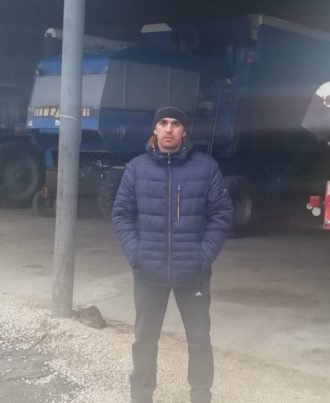
“Fertilizers are expensive, yet people apply them without knowing whether they are actually needed. We need to keep moving toward better decisions! After the agro-diagnostics, I now know that my fields have sufficient potassium, so I can save on that, while phosphorus and nitrogen need to be applied at higher rates.
If you have soil analysis data, know what you planted and how many nutrients the crop removes, you can calculate how much fertilizer needs to be applied. AgriLab conducted agro-diagnostics, and now I know exactly what the nutrient situation is across my fields. I know what to apply and how much.
We need to monitor soil fertility indicators. I have conducted agro-diagnostics now, and I will repeat the analysis in a few years. Then we will be able to see whether we have improved the indicators or made them worse. Naturally, we want to improve them!”


