
In the Field Like in a Laboratory: How Precision Farming Works — The Experience of Agrobiznes Agricultural Farm
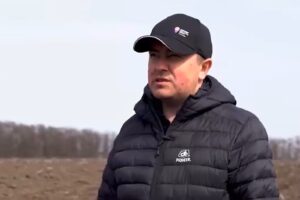
Oleksandr Vakhnii has been working at Agrobiznes Agricultural Farm since 2011. He started as Chief Agronomist and now serves as Deputy Head of the farm. The farm grows winter wheat, spring cereals, buckwheat, soybeans, and sunflower, while also developing its vegetable production, with carrots, beets, and onions as its main crops.
“We developed the vegetable production sector in response to market demand. We started with carrots, then added beets and onions based on customer demand. For four years now, the farm has been consistently growing these crops, with a focus on quality and market needs,” says Oleksandr.
The farm has fertile chernozem soils with favourable conditions for winter crops and late-sown spring crops. However, in dry years, early spring crops suffer from insufficient moisture. That is why particular attention is paid to crop rotation, fertilizers, and the crop nutrition system. To avoid yield losses, it is essential to know exactly what each field’s soil contains and what it lacks. This is why soil analysis and a well-balanced crop nutrition system have become key tools for Agrobiznes Agricultural Farm in maintaining stable yields.
The war has also brought new challenges: some of the harvest could not be sold, prices did not increase due to logistics problems, and power outages became critical for vegetable storage. As a result, the farm faced losses both in terms of produce and its value.
Despite everything, the farm continued to introduce modern technologies in order to remain resilient.
Quality Starts with Understanding the Soil
Oleksandr’s team had previously worked with AgriLab, but it was not possible to survey all the fields. As a result, decisions sometimes had to be made without a complete picture. Some areas received too much fertilizer, while others received too little. This affected both yields and product quality and led to inefficient use of resources.
In 2024, Agrobiznes Agricultural Farm joined a project supported by the USAID AGRO Program and AgriLab, which made it possible to increase the area covered by the research 2.5-fold.
As part of the support, the farm received the following services on preferential terms:
- soil sampling,
- analysis of the results,
- an audit of the existing machinery to assess its potential for implementing precision farming elements,
- consultations on optimizing crop nutrition without unnecessary costs.
What the Soil Analysis Revealed
The field survey showed that most fields have high organic matter content and neutral soil acidity. Phosphorus and potassium availability ranges from medium to very high. Zinc content, which is particularly important for corn and legumes, varies from low to very high.
Such variability in soil parameters demonstrates the need for an individual approach: fertilizers need to be applied at different rates not only across different fields but also within individual fields. This is where variable-rate application technology comes in, allowing the farm to plan crop nutrition more precisely and avoid unnecessary spending.
According to Oleksandr, systematic analysis has made it possible to:
- monitor the balance of macro- and micronutrients,
- track organic matter levels;
- adjust the crop nutrition system according to the needs of each field.
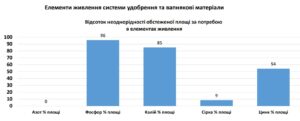
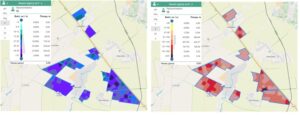
A follow-up field survey showed that organic matter levels are gradually increasing, while the area with higher phosphorus content is expanding. The farm is already using variable-rate application technology for phosphorus, potassium, and zinc.
In 2024, the farm purchased a modern fertilizer spreader that allows potassium fertilizers to be applied at the required rate for each part of a field. This is important not only for drought resilience but also for crop quality, particularly for vegetables. The next step is to apply the same approach to phosphorus and micronutrients.
“Now we can clearly see where and how we need to work. This allows us not only to save money but also to grow higher-quality crops,” Oleksandr adds.
How Variable-Rate Fertilizer Application Was Implemented and What Results It Delivered
Implementing the recommendations developed by the AgriLab team will help optimize fertilizer costs, increase yields in different field zones by 5–23%, and preserve soil fertility in the long term.
This cooperation provided practical tools for transitioning to precision, profitable farming.
“The main thing is not simply to reduce costs or increase yields, but to understand the condition of the soil, how it is changing, and how to prevent its depletion. That is why we are moving toward variable-rate fertilizer application, planning to carry out comprehensive diagnostics of our vegetable fields, and want to continue working with the land in a systematic and comprehensive way,” Oleksandr concludes.
This material was prepared as part of a project implemented by AgriLab with the support of the AGRO Program. We thank the American people for their support.

