
What is VRT during fertilization and sowing? With what should you start and which technique will be useful?
The desire to improve the results pushes farmers and farm managers to find new technological solutions. Either way, most come to precision farming. One of the elements of the system of precision farming is the technology of differentiated fertilization and seeding. A large number of large farms and holdings have already studied technology and work exclusively for it, while small businesses are only on the way to full development.
Differentiated fertilization
The personal approach to each field and the study of soils will form the basis of the beginning of the path to precision farming technology. In order to understand what is going on in the soil, that is, in what conditions it is necessary to start work (namely the type of soil, the contents of micro and macro elements, an organic component) and what field needs elements, it should be investigated, analyzed and formulated as a strategy of work as map-tasks for sower, sprayer or fertilizer applicator.
From soil research to the creation of map tasks, you need to take some interesting steps: soil scanning to detect field inhomogeneities, the development of a strategy on soil sampling for analysis in the zones of these heterogeneities, and, after obtaining results from the laboratory, to form a map of tasks for fertilizing.
The result of the strategy can be analyzed through satellite or unmanned monitoring of crops during the vegetation or through yield maps derived from the combine.
First of all, we will try to answer the question: what is the map -task?
Map-task – is a geographical map that contains information on the rates of application or sowing, through which technicians can apply the appropriate norm to a specific location using re
For an example, take a seed map. The picture shows a field with four different zones marked with numbers. This example demonstrates that in the first zone 28 thousand seeds per acre will be sown, in the second 30 thousand seeds, in the third – 34 thousand seeds, and in the fourth – 32 thousand.
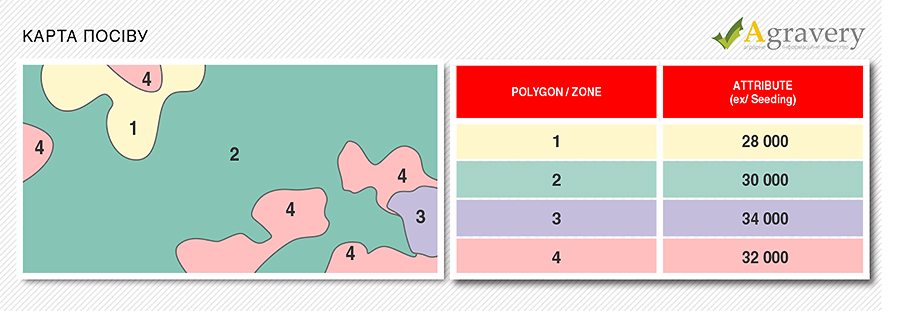
The number of columns of a prescription may vary in their number and the name can be provided by user. It should be noted that for each zone it is also possible to select higher or lower seed rates, several different types of hybrids, simultaneous fertilization, etc.
There are many applications to create such maps, but the most popular are FieldView by Climate, Farm Works by Trimble, SMS by AG Leader, and other GIS applications like QGIS.
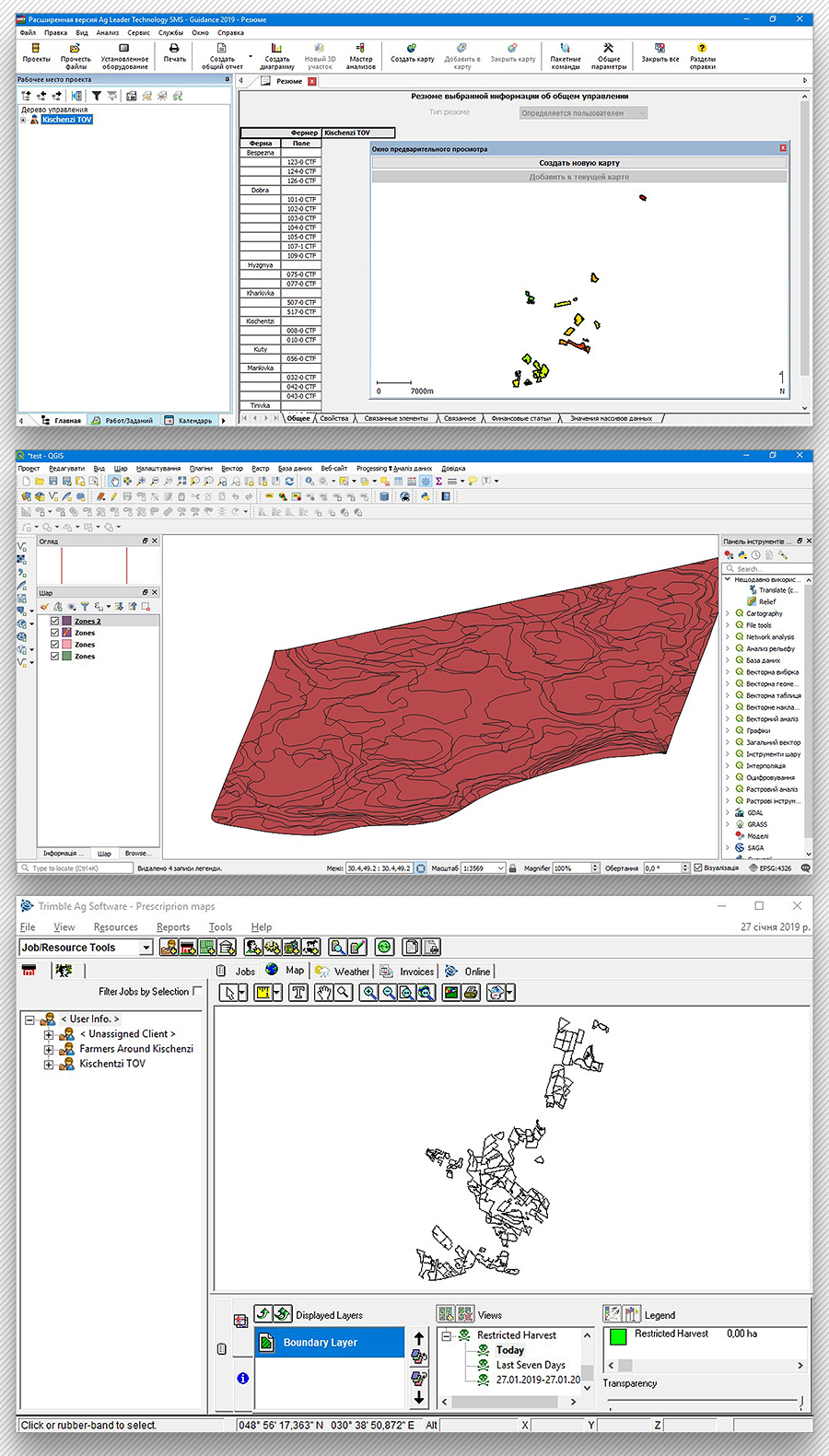
Program interface appearance for creating map-tasks on the example of SMS by AGLeader, QGIS, Trimble.
Consider the most common way of forming maps, based on the soil agrochemical analysis because it allows you to respond to the result quickly.
AgriLab is the leader in providing system solutions for increasing the efficiency of agribusiness and conducting a complex soil analysis for a detailed examining of soil covering , assessment of its heterogeneity and the expediency of introducing VRT technologies with an elemental grid of 10 hectares, but it’s often used a smaller grid of 5 to 3 and even 1 hectare: the more heterogeneous conditions (soils, relief, irrigation, etc.), the greater detailing should be used.
The next step is to create a map -task. To this stage, it is necessary to define zones with different potential for yield and level of ensuring of nutrition elements, to define the form of fertilizers and the norm for differentiated fertilization on each heterogeneous area of field.
The differentiated fertilization of complex fertilizers involves the impact on the fertilization zone of all the elements, which are included in its composition. For example: we introduce NP (S) 20:20:14 and close the need for phosphorus. Accordingly, the introduced elements affect the rate of nitrogen and sulfur.
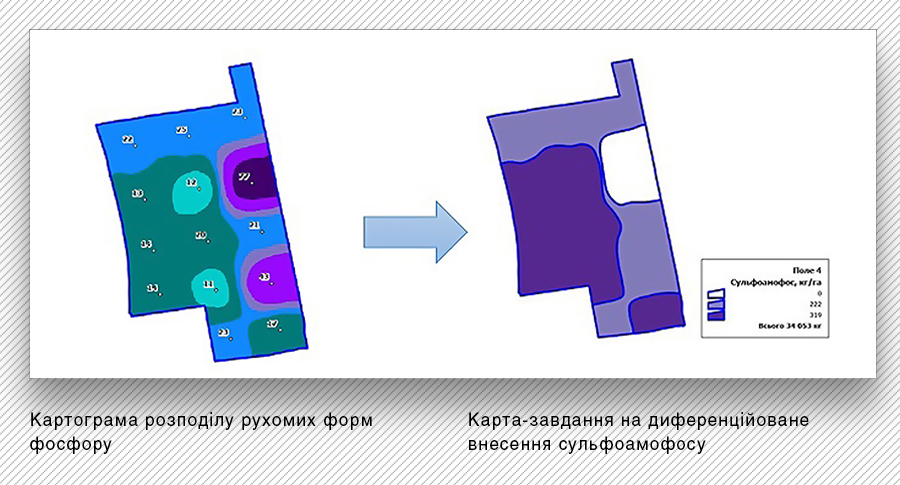
photo: agrilab.ua
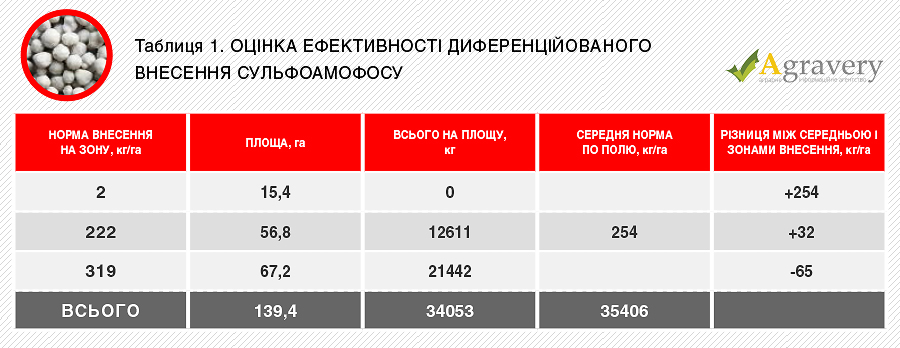
For example, there is a zone in map-task, where there is no need for phosphate fertilizers. This area occupies 11% of the total area. If we were apply the average weighted norm of NP(S) 20:20:14 into this zone, we would receive a over application of 254 kg / ha. In the zone with applicatiom of 222 kg / ha, the over application would be 32 kg / ha, and in the zone with the need of 319 kg / ha –there was the lack of application of 65 kg / ha. In general, the NP(S) 20:20:14 savings with differentiated fertilization is 1.35 tons. At the same time, fertilizers were applied in plots as much as necessary to optimize the conditions of growth and development.
EXPERT COMMENT
Yuriy Hanenko, chief agronomist of “Agro-Rythm”, Vinnytsia region.
– Our farm property two years ago began a soils laboratory analysis in isolated plots. However, today more than 2 thousand hectares have been investigated. It is difficult to talk about financial efficiency, because soil testing showed their complete exhaustion. Earlier we applied 100 kg, but now the cartogram recommends to apply 170 kg. That is, the maximum efficiency leads to higher costs. However, this is only the beginning in which we are trying to work ahead, today’s investment is the future profit from the land.
 Iaroslav Boiko, СЕО AgriLab, representative of the International Society of precision agriculture in Ukraine
– Investments in some elements of precision agriculture are returned in the first marketing year. For example, VRT technology and ASC allows to conduct seeding with automatically controlled variable sowing rate of seed within heterogeneous area of field. This enables to achieve optimal plant density on different parts of the field, as well as to effectively use the resources and potential of each section of the field, in particular, different stocks of nutrients, productive moisture, distribution of light, etс. The experience of using the VRT technology in Ukraine indicates that the increase of yield in field reaches an average of 10% and above comparing with the use of one seed rate. Using the ASC technology during corn sowing allows to avoid over covering and excess of plant density and allows to save from 3 to 8% of seeds. Differentiated fertilization technology allows optimizing the use of resources up to 40%, and in some cases more. Even the first, the easiest step to precision agriculture, which does not require significant expenses – soil analysis and mapping of its properties, makes it possible to optimize the use of resources and increase the efficiency of technology up to 20% and more.
Differentiated seeding
The next logical step is a differentiated seeding. There are different opinions about this, someone believes that it is enough to align the “background” of the field and sow with the established norms, and some are supporter of complex technology (fertilizers + seeding).
The bases for zone forming for differentiated seeding and cultivation can be:
- yield maps;
- NDVI images;
- soil analysis;
- Analysis of NDVI images for 5-6 years to create a Field Health Map, etc.
For example, let’s review the approach using four factors:
- soil analysis of heterogeneity and organic content
- determination of the zones for sampling and analysis
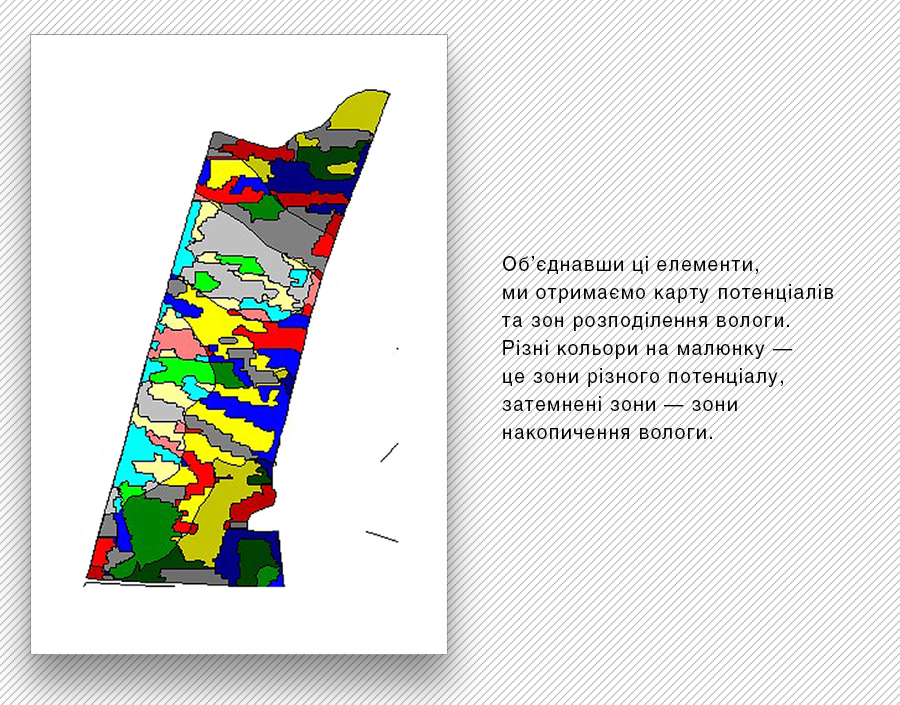
- analysis of zones of high and low potential
- slope factor (map of heights).
EXPERT COMMENT
Ivan Dyneko, specialist in precision farming systems LLC “Kischency” (7 years of experience)
– The idea of precision agriculture is a complex and multi-component work, but not a point approach. It is a work-intensive process, from soil analysis to the analysis of yield maps from the technological side; equipment of autopilot of self-propelled machinery, installation and management of a set of modern elements on trailer units (spreaders, continuous and precision seed drills, cultivators, feeders, etc.).
This process should begin with the measurement of the fields contour, the study of soil, combining of the existing “iron” (ie, studying what is needed to reveal the full potential of the existing fleet of technology). By choosing for yourself one clear line of work, keep it in spite of the instant result. It will come, just this will take time.
Technique for differentiated seeding
Almost all modern seeders are already equipped with the necessary components for differentiated seeding. Older models of seeders usually used a mechanical drive to seed, and some owners of “outdated iron” dare to re-equip.
The main condition for the operation of differentiated seeding, that is, an element, which changes the application range, is the hydraulic or electric drive of the seeding machine. Today, there are several tools for sowing with variable norms, either the purchase of an entirely new car or the re-equipment of the seed drill available on the farm. Precision Planting products are, of course, the leader in developing the latest technical solutions for differentiated seeding. The re-equipping kit includes: a sowing machine with an electric drive with a wide range of components and a control monitor. The cost of the basic Precision Planting equipment for the differentiated seeding on the eight row drill costs – 26 thousand dollars with VAT, and for sixteen row – 39,3 thousand dollars with VAT. Speaking about “ready” seed drills with electric drives of the sowing machine, it is possible to distinguish Massey Ferguson 9100 White Planters by AGCO, which in factory configuration already have products by Precision Planting with a value of at least $ 100,000. Precision Planting’s major competitors in the development of precision seeding systems are John Deere’s Exact Emerge and Horsch systems with their flagship Maestro model.
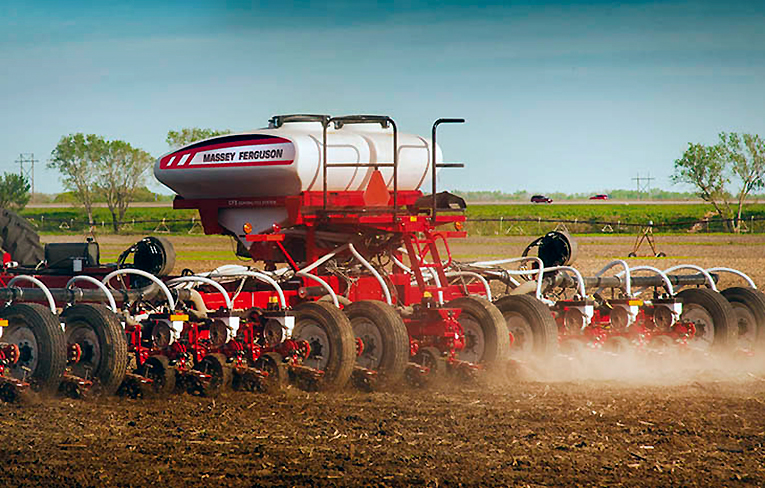
Massey Ferguson 9100VE Precision Planting Seed drill for cultivating crops.
Photo: amacoint.com
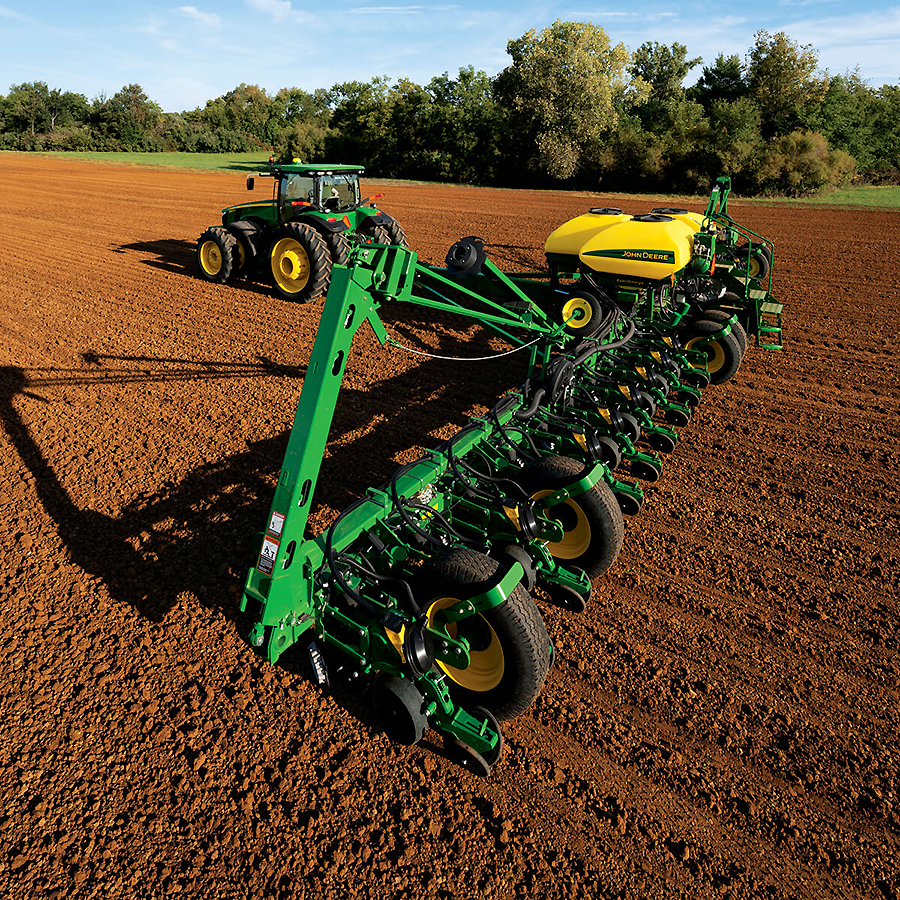
John Deere seed drill with Exact Emerge system.
Photo: realagriculture.com
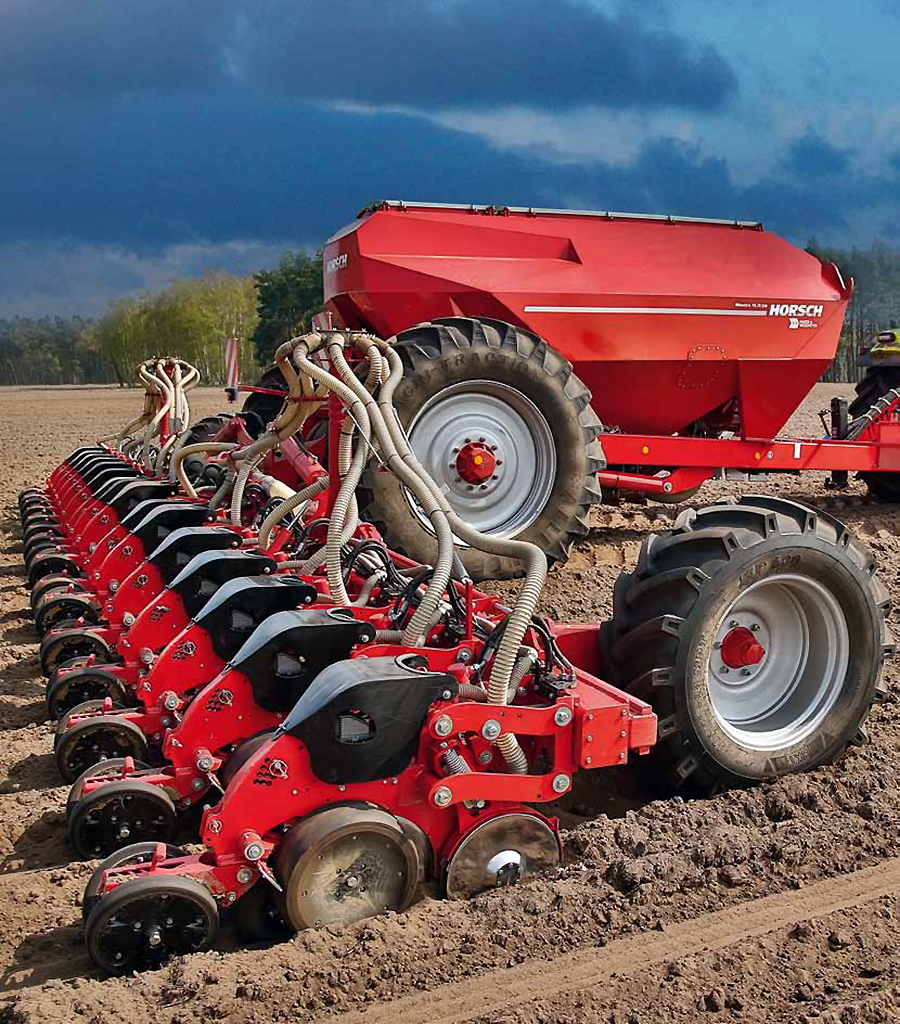
Horsch Maestro seed drill. Photo: horsch.com
EXPERT COMMENT
Yuriy Rosomakha, engineer of LLC “Khavsters”
–There are not many customers interested in differentiated seeding in Ukraine. Such technology begins to be practiced by holdings that have entire departments of precision farming in their structure. Small farms are not yet ready to experiment. However, due to errors in the economic efficiency of investments, the payback period of equipment from Precision Planting is less than two years, which is quite fast as for the investment. If you equate the purchase of a new seeder to the re-equipment of an existing car, then the second option is much cheaper, because 50% of the cost of the new seeder falls on the frame, hoses and tires with wheels. Everyone chooses, to pay for a glossy paint, or for equipment that brings money.
Precision Planting moved forward and developed a Smart Firmer scanner. It is installed directly on the section of the drill instead of the well-known slider of Keeton Seed Firmer. During sowing, the scanner moves and determines the presence of moisture at the depth of seed gain, soil temperature, purity and uniformity of the seedbed, and most importantly – it evaluates organic matter and and do the result in a percentage (from 1 to 6%).
First of all agronomist sets the output parameters for each result (legend). For example, at 3% of organic matter, 60 thousand seeds are sown, at 4% – 65 thousand seeds, and so on. Accordingly during movement, the sensor scans the soil, gives the result and the seed drill changes the seed rates on each row. Cost of the sensor – 1 thousand dollars with VAT per row. The minimum number of sensors necessary for the correct operation of the equipment is one sensor on the four rows of the drill.
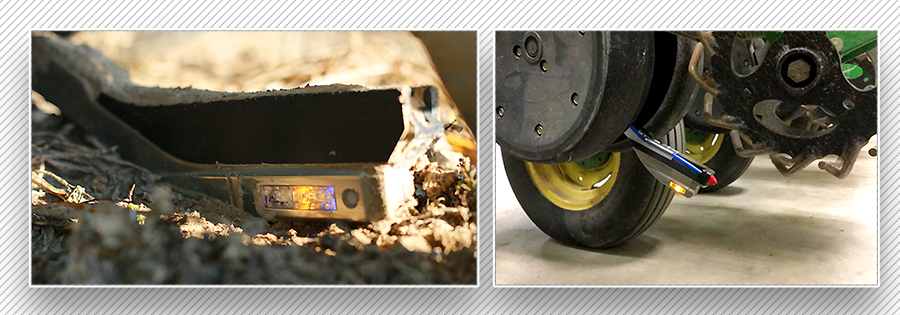
Smart Firmer scanner by Precision Planting. Photo: precisionplanting.com, maquinac.com
The technical task is the next step in shaping the technological process at the enterprises. The issue of economic efficiency in the transformation of crop growing technology will be the main starting point for the initiatives. In the case of differentiated seeding and fertilization, recognizing one of them as 100% effective is difficult because the approach that works in your fields and gives the results in through strategy.
In our next publications, we will give a more detailed overview at each link of precision agriculture, with a focus on the nuances and economic components of all processes.
Kateryna Shevchenko, editor of the mechanicsPRO category

