
Field experiment: qualitative soil analysis affects the profitability of the company
Soil analysis takes top-places among the important components of agricultural production technology. It is practically proved that due to this you can additionally get $ 150 per hectare of field or save money on the crop production! Such data was obtained as a result of the experiments of AgriLab, which were conducted on land of agriholding in Chernihiv region,when growing corn for grain.
1st experiment: reduce production expenses
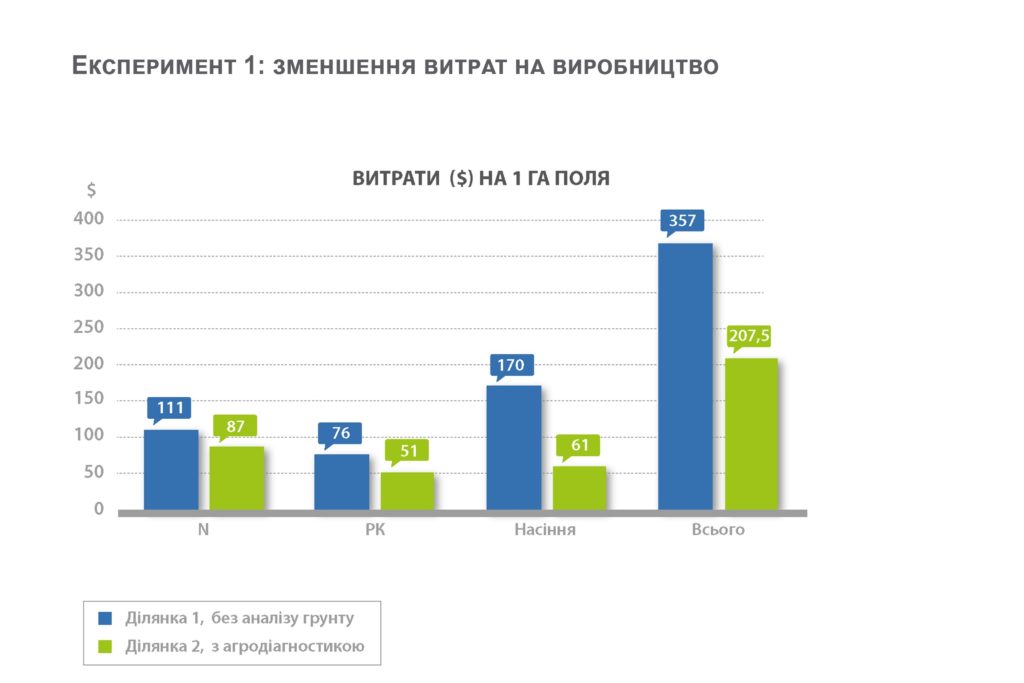
103 ha field was devided into two areas. On first area was used common technological map on massive, developed by agrarians of agroholding. The second one were used recommendations provided by specialists based on the results of complex agrodiagnostics taking into accounting natural potential of field on the basis of agrochemical soil analysis, weather and climatic conditions and critical factors for the growth and development of plants.
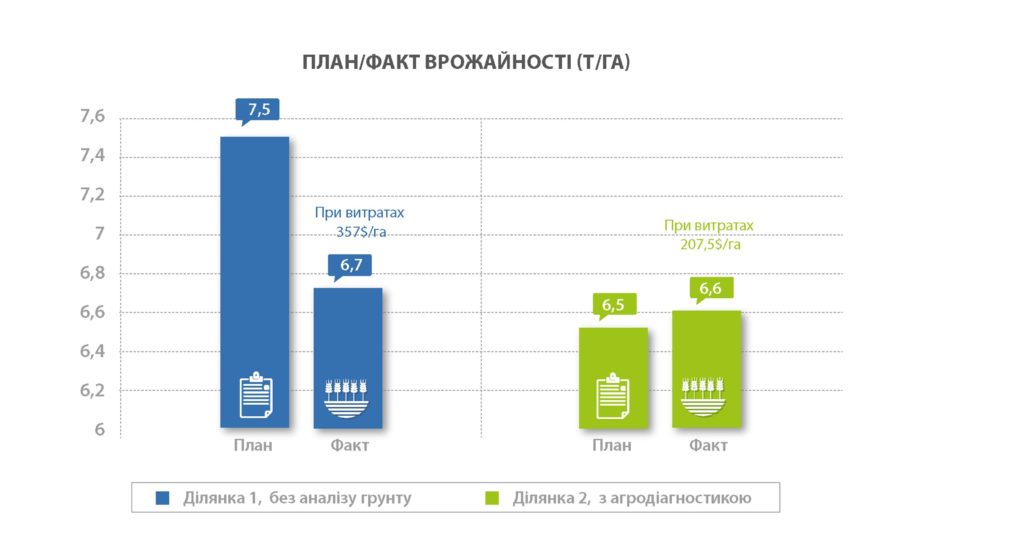
On the first area agronomists indicated planned yield of corn on the level of 7.5 t/ha. To achieve this goal, the cost for nutrition system was $ 187 / ha, including: nitrate fertilizers – $ 111 / ha, phosphorus and potash – $ 76 / ha. Decided don’t save money on seed material and purchase high quality seeds of foreign selection (premium class), which cost $ 170 / ha. In total for corn growing was spent 357 $ / ha.
On the second one our specialists conducted complex agrodiagnostic and determined field potential on the level of 6.5 t/ha. It means, that no matter what fertilizers were applied, 7.5 t/ha of corn yield was unlikely to get due to a number of natural limiting factors. Talking in economy language : more fertilizers – more expense, but not yield. Hence, according to the field potential 6.5 t/ha was optimized the nutrition system : norms of nitrogen, phosphorus and potassium were calculated, which were lower to ensure the planned yield. Thus, the costs for nitrogen fertilizers amounted to 87 $ / ha ($ 24 / ha less than in the first section), phosphorus and potassium – $ 51 / ha ($ 25 / ha less).
Also, given field potential, it was recommended to replace premium seeds with cheaper material from domestic producers, which cost $ 61 / ha. Total for production, including the cost of complex agrodiagnostics, was spent $ 207.5 / ha, while in the first section – $ 357 / ha.
What did we get as a result? The actual yield of corn in the first section was … 6.7 t / ha while expense was $ 357 / ha, while the planned was 7.5 t / ha. In the second section received what they planned – 6.6 t / ha while expense was 207.5 $ / ha. That is, due to agro-diagnostics, the farm managed to save $ 149.5 / ha.
2nd experiment : additional profit
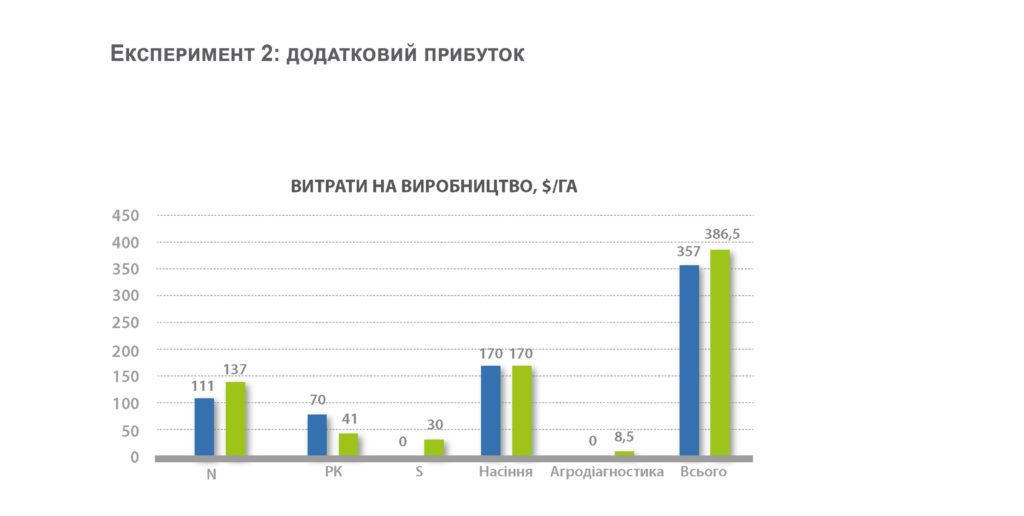
In the same agroholding in the Chernihiv region, a similar experiment was conducted. The field, with an area of 74 hectares, was divided into two identical areas. At the first, the general technological map of the agroholding company was used, and on the second, the recommendations of AgriLab specialists, created on the basis of the results of complex agrodiagnostics.
In the first section, the planned yield was 7.5 t / ha. The costs for the system of nutrition and seeds -357 $ / ha. After conducting soil agrodiagnostics in the second section, the experts determined the potential yield at the level of 8.5 t / ha. To achieve it, the nutrition system was changed: they increased the norm of nitrogen fertilizers, reduced – phosphorus-potassium, and also added sulfur to the system, which was not foreseen in the technological map of the agroholding in general. As a result, the nutrition system in the second section was more expensive at 29.5 $ / ha (including the cost of soil analysis).
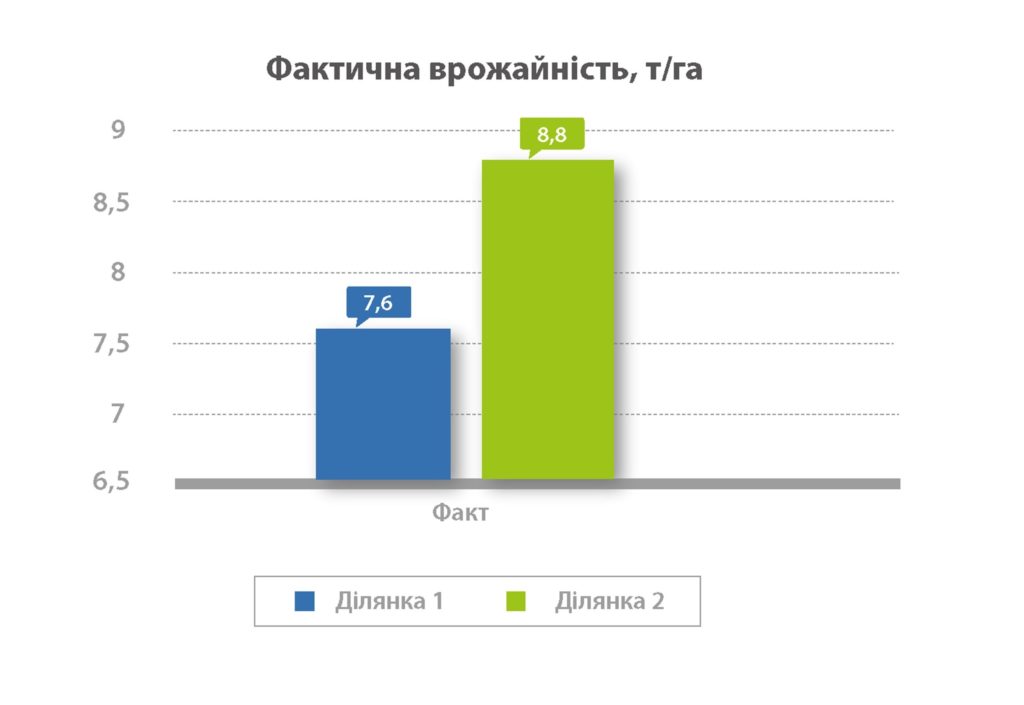
What the approach was the best? The answer was given by the harvest. On the first section was gethered 7.6 t / ha, on the second – 8.8 t / ha, ie – 1.2 t / ha more. Thus, at an area of the field where agrodiagnostics was conducted, they received 150 $ / ha of additional profit.
The experiments carried out have proved: soil analysis, above all, is economically profitable. The rule of “plenty is no plague” in agribusiness – does not work. Sometimes you have to spend less to get more. Sometimes – on the contrary. But what option to choose? Finding the right decision begins with soil analysis!
Magazine “Агробізнес Сьогодні”, №23 (390), december 2018

